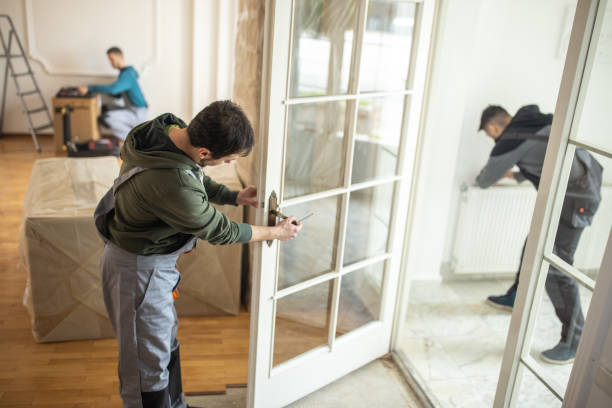
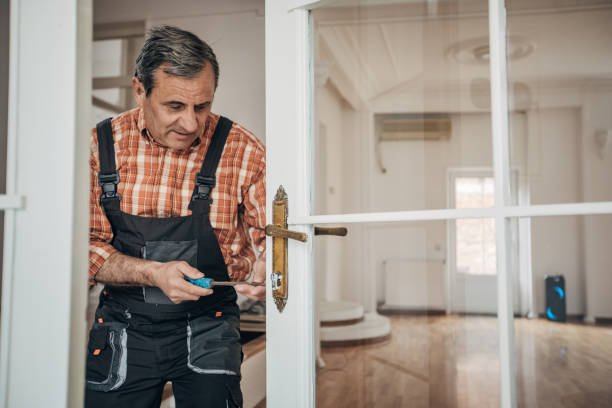
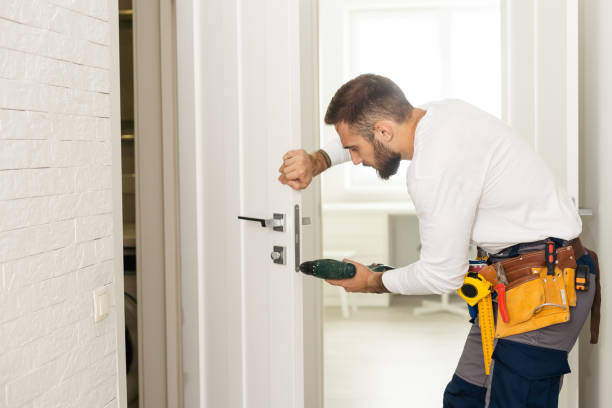
When you move into a new home, fire a disgruntled employee, or lose a set of keys, your property's security is compromised. You don't know who has a copy of your key. However, running out to the hardware store to buy entirely new locksets is often an expensive and unnecessary hassle. We provide professional lock rekeying and repair services across Roaring Spring, PA. We manipulate the internal mechanics of your existing hardware, rendering old keys useless and restoring total access control to your property for a fraction of the cost of replacement.
Call for fast locksmith help
A standard deadbolt contains a cylinder filled with small brass pins of varying lengths. The correct key pushes these pins to a perfectly aligned "shear line," allowing the cylinder to turn. When we rekey a lock, we remove the cylinder, discard the old pins, and insert brand new pins that correspond to a completely different key pattern. Your old hardware remains on the door, but the old keys will never turn it again. We then provide you with a fresh set of keys.
Do you have a heavy keyring pulling down your pocket? We can streamline your life. We can rekey the front door, back door, garage, and side gates so that one single key opens every lock in your house. For businesses in Roaring Spring, PA, we design complex Master Key Systems, allowing managers a single key to open all doors, while restricting employee keys to only their specific offices or zones.
Standard hardware store deadbolts are highly vulnerable to lock bumping and drilling. If you want to fortify your home's perimeter, we install high-security cylinders (such as Medeco, Schlage Primus, or Mul-T-Lock). These locks feature anti-drill hardened steel inserts, side-bitting pin variations, and restricted keyways, meaning nobody can duplicate your key without your authorized signature card.
Regain total control over who has access to your property. Let our security experts rekey or upgrade your locks today with precision and speed.
Call for a rekeying estimate
"We just bought our first home and wanted to make sure nobody else had a key. They came out the same day we closed, rekeyed all 5 doors to a single key, and charged a very fair price."
"I run a retail store and had to let a manager go. I called them at 6 PM, and they were there by 7 PM to rekey the front doors and the office. Great peace of mind."
"The deadbolt on our front door was constantly jamming. Instead of making me buy a new $150 lock, the technician took it apart, fixed a bent piece inside, and now it works perfectly."
Roaring Spring was established around the Big Spring in Morrison's Cove, a clean and dependable water source vital to the operation of a paper mill. Prior to 1866, when the first paper mill was built, Roaring Spring had been a grist mill hamlet with a country store at the intersection of two rural roads that lead to the mill near the spring. A grist mill, powered by the spring water, had operated at that location since at least the 1760s. After 1867, as the paper mill expanded, surrounding tracts of land were acquired to accommodate housing development for new workers. The formalization of a town plan, however, never occurred. As a result, the seemingly random street pattern of the historic district is the product of hilly topography, a small network of pre-existing country roads that converged near the Big Spring, and the property lines of adjacent tracts that were acquired through the years for community expansion. The arterial streets of the district are now East Main, West Main, Spang and Bloomfield, each of which leads out of the borough to surrounding townships. Two of these streets — Spang and East Main — meet with Church Street at the district's main intersection called "Five Points." The boundaries of the district essentially include those portions of Roaring Spring Borough which had been laid out for development by the early 1920s. This area encompasses 233 acres (0.94 km2) or 55 percent of the borough's area of 421 acres (1.70 km2). Since the district's period of significance extends to 1944, most of those buildings erected after the 1920s were built as infill within the areas already subdivided by the 1920s. In the early 1960s, the borough began to annex sections of adjacent Taylor Township, especially to the east around the then new Rt. 36 Bypass.
Zip Codes in Roaring Spring, PA that we also serve: 16673